Showing posts with label baseball. Show all posts

Apr 29, 2014

the short baseball life of Luther Lane Stuart

I'm not sure what drove me to imagine a major league ballplayer who had one monstrous at-bat, and then never did anything at the plate again. That vision, of course, led me to Google, which led me to a Wikipedia page that is both insightful and tragic. If the Wikipedians are to be trusted--and the Baseball Almanac corroborates--as of this date, there are 114 big-leaguers who smacked a home run in their very first at-bat. Eighteen of those men have since retired from the game with only that single dinger to their name. (Four others are still active, and who knows what glory awaits?)

None of those players exactly fits the description, as all had plate appearances to follow their lone homer.

One comes close, though: Luther "Luke"
Lane Stuart.


Luke Stuart played a grand total of three games for the St. Louis Browns in the late summer of 1921. In his first time up, he walloped an inside-the-parker off the inimitable Walter Johnson, becoming the first of only two MLBers to clear the bases the hard way in their debut. (The other: Johnnie LeMaster.)

Stuart is one of eleven alumni of the Guilford College Quakers to reach the big leagues. As Charlie Bevis describes in his biography of the one-hit wonder,
On August 8, at Griffith Stadium in Washington, Stuart again played in the late innings of a blowout, this time for McManus. Washington scored seven runs in the bottom of the eighth inning to push the score to 16-3 when St. Louis came to bat in the top of the ninth inning against future Hall of Fame pitcher Walter Johnson. With a 13-run lead, there were likely few spectators left in the stands, and probably even fewer newspaper writers. Those who stayed witnessed Stuart crack a two-run home run off Johnson to make the final score 16-5.
After an 0-2 outing in his next game, Stuart was sent back to the minors, where he spent the rest of his career--three short years. After time away selling insurance and real estate, Stuart circled back to baseball, scouting for the Yankees.

Perhaps already succumbing to a fatal condition, Stuart died at his own hand 21 years later.

The North Carolina Room blog has a great two-part summary of his life and context. In the first part, you learn that Luke Stuart once saved a teammate from an opponent / gangster by the name of Snipes. In the second, you learn more about Stuart's career, and his post-baseball existence. Both are interesting slices of Americana, and just another reason to love the Internet.

Nov 10, 2010

"Swung on and belted!"

Dave Niehaus, the soul of Mariner baseball, has passed away at seventy-five. In his honor, 710 ESPN has compiled some of his most memorable calls, late summer sunshine for a cold November night.


More audio at MyNorthwest.com

Aug 24, 2010

journey to The Bigs

I'm a little jet lagged from a trip to the East Coast, so the next couple posts are going to be link-heavy travelogues. But not mine, because I'm tired and hungry with a brain and stomach three hours ahead of schedule.

In the first series, Jim Caple slices up life at every level of professional baseball in Washington state (with a quick jaunt to its northern neighbor). It's of interest to baseball fans, Pacific Northwesterners, and, most of all, students of the American Dream: doing what you love and being paid for it.

Caple begins his odyssey in Walla Walla:
This fertile region grows everything from wheat to grapes to onions, and pretty much everyone is planting their own dreams here, hoping they'll take root. The general manager sitting behind home plate dreams of running a major league team. The young man in the play-by-play booth dreams of calling games for a top pro team or a big Division I school. The enology and viticulture student running the concessions dreams of operating a world-class winery. Even Sweet Lou, the giant onion mascot, is dreaming up routines for next season.
Continue with him to Victoria, Everett, and Tacoma--and, if you're one of a lucky few, stride into Safeco Field with a number on your back and a fatty paycheck in your pocket. The vast gulf between the majors and the minors will never seem vaster.

And when you're done, watch Sugar.

Jun 25, 2010

the ones that got away

Jeff Sullivan tackles the myth that ex-Mariners inevitably thrive upon exiting Seattle. A sample:
Cha Seung Baek: Traded to San Diego. Made 20 standard Cha Baek starts, got hurt, disappeared. Still has no reason to smile. Not better.

Wladimir Balentien: Traded to Cincinnati. Was okay, then lost his job. Demoted to AAA, where his OPS is under .700. Not better.

Miguel Batista: Signed with Washington, where he has more walks than strikeouts in relief. That the Nationals are rebuilding makes this doubly hilarious. Not better.

Adrian Beltre: Dominating in Boston with 33 extra-base hits and his usual defense, albeit with a few errors thrown in. Becoming popular for hating when Victor Martinez touches his head. Predictably better.
It's a nice reminder that confirmation bias is the enemy of rational fandom--if there is such a thing.

Also, don't bet on sports.

Jan 30, 2010

your homework, due April 4th

Baseball websites are bursting at the seams with statistics of every stripe. (Yes, I went there--twice.) And now, remarkably, you can find a series of the web's best intros to the various methods of sabermetrics all in one place.

Now you have no excuse.


[via Dave Cameron]

Dec 13, 2009

the eye of--and on--the storm

Peter Gammons recaps 20 years with ESPN.
ESPN sent me to every World Series in those 20 years. In 1991, when I got out onto the field at the Metrodome six hours before Game 6 between the Braves and Twins, Kirby Puckett was coming out to take early BP before the lights were fully turned on. "Petey," he yelled at me. "When you go on 'SportsCenter' before the game, tell 'em Puck's gonna put the Twins on his back. I ain't done [----]. This is going to be Puck's night. Tell everyone in ESPN land." Four hits, a game-saving catch and a game-winning homer later, there was a seventh game, perhaps the best game I've ever seen. Jack Morris-John Smoltz. Morris outlasted the great Smoltz; the Twins won in the 10th, 1-0; and at 5:30 a.m., Morris came back to the field to do a Sunday Conversation for "SportsCenter."
Twenty years of triumph and turmoil that changed the face of the sport--of all sports--and Mr. Gammons was a level-headed, supremely professional reporter, a voice of reason and sanity in the middle of it all.

Enjoy your retirement, Mr. Gammons. You will be missed. See below.

Nov 23, 2009

the next Maddux?

Zach Greinke: not just a pitcher's pitcher, but a stathead. Ever since Greg Maddux retired, we've needed a bellwether nerd on the mound. Thank goodness for Zach Greinke.

Oct 2, 2009

throw more curveballs

Steven Levitt and Ken Kovash claim that pitchers, among other athletes, are too predictable:
They first analysed over 3 million pitches thrown in major-league baseball games between 2002 and 2006. For each type of pitch, they measured the batter's "OPS" – a number that represents how likely a batter is to reach a base or to make a big hit. They found, on average, that fastballs tended to give batters 20 per cent higher OPS than curveballs.

If pitchers played according to minimax, the OPS for curveballs and fastballs should be the same, but in fact pitchers gave batters a slight edge by throwing too many fastballs.

Levitt and Kovash then looked at whether or not pitchers chose their pitches as unpredictably as minimax theory says they should. They found that when a pitcher threw a fastball, his next pitch was 4 per cent less likely to be a fastball as well. If pitchers played truly rationally, there would be no such bias towards switching the type of pitch. "Pitchers are being just a little too cute on the mound when they're switching back and forth so often," says Kovash.
Read the entire thing for the (predictable) caveats and nay-saying. OPS isn't the be-all end-all of baseball stats, for one.

I wonder how a pitcher who dialed up pitches totally randomly would fare in the bigs. It could be pretty interesting: randomness means the possibility of, say, throwing five fastballs in a row, then a curve, then four more fastballs. There'd be no such thing as a "fastball count," and a batter who thought that a curveball was "due" would fall prey to the gambler's fallacy.

Sep 7, 2009

1.7 decades of futility

No matter how terrible your sports franchise of choice has been over the past couple decades, at least it's probably had a winning season or two. No such luck for Pittsburgh's baseball fans: the last time the Pirates had a winning season, Bob Dole--no stranger to failure--was still a senator dreaming of the presidency. ESPN has the story:
The Chicago Cubs assured the Pirates of an unwanted place in baseball's record book, getting two homers from Derrek Lee and an effective start from Ted Lilly while beating the last-place Pirates 4-2 on Monday.

By losing their 10th in 11 games, the Pirates are guaranteed of finishing below .500, just as they have every season since 1993. The 17 consecutive losing seasons represent the longest streak for any team in the four major North American pro team sports, and only the Phillies (1933-48) have also had as many as 16 in a row.
That the Cubs are the ones cementing the Pirates' place in the record books is an irony as sweet as Bob Dole's peanut butter.

Aug 11, 2009

a monopoly on nostalgia

Topps, maker of some of the ugliest baseball cards in existence, has crowded out its last major competitor, Upper Deck, by signing an exclusive agreement with Major League Baseball. Slate's Dave Jamieson has the story--and the history--behind the move.

When I was a kid, I bought Donruss, Fleer, or Topps packs with whatever change I could scrimp from chores, blissfully unaware of the economic forces at play. (Upper Deck? Who had that kind of money?)

Now I'm nostalgically disoriented.

Aug 4, 2009

he fielded it... with science!

Jack Wilson, Seattle's new shortstop, serves up a little science to The News Tribune's Larry LaRue:
“I started to watch a batter’s hands and feet, his elbow and shoulders, his swing pass. Then, depending on your pitcher and what pitch he’s about to throw, you know what the hitter is most likely to do,” he said.

“I got good enough that in Pittsburgh, they let me set the infield defense. I moved an outfielder one time and one of the coaches asked why. I showed him the video of the hitter’s first swing and said, ‘Look at that. There’s no way he was going to be able to pull a ball with that swing.’ After that, they trusted me.”

It was more than study in the field. Wilson read up on the opposition.

“If a guy is in a slump, for instance, what’s he going to try to do? Keep the ball up the middle, go the other way. That’s how you try to get out of a slump,” Wilson said. “Pulling the ball gets you into slumps, it doesn’t get you out. So if a guy is in a slump, it doesn’t make sense to play him to pull.”
Glad to hear Wilson takes the Greg Maddux to the game: study, discipline, maximum effort--a welcome change from the laissez faire style of his predecessor.

Just stay out of Wilson's way when he's heating the Florence flask.


Update: The Times' Larry Stone explains why Wilson chose baseball over soccer--and how the world's game has helped him compete in America's pastime.

Jul 25, 2009

a perfect night for baseball

For a late father's day gift, I took Dad to yesterday's game at Safeco. Dad summed it up best. "I feel like I had a night on the town: chauffeured around, treated to dinner and entertained by a three-hour tragedy."

I hadn't planned on the last part, but there it was. On an otherwise perfect night for baseball, with a cool ocean breeze wafting into the stadium, the Mariners got shellacked by Cleveland, 9-0. The game might have slammed the door on their playoff hopes.

At least we each walked away with a Franklin Gutierrez bobblehead.


First, dinner at the Pyramid Brewery. We sat above the busiest kitchen in existence.


Down the third base line, during Cleveland's batting practice.


The view dead ahead.


Take it seriously.


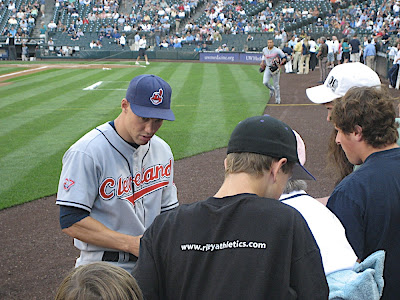
Grady Sizemore, homebody, signs a few autographs before the game.


By the 9th, about half the crowd had disappeared. These lads were happy to grab front-row seats during the fateful inning.

Jul 15, 2009

why we love Ichiro, part XXIV


Ichiro meets Obama at the All-Star Game, July 14, 2009.

Guess which one doesn't have the weight of the free world on his shoulders?

Added 7/16 U.S.S. Mariner has the official, hi-res, solemn shot.

Jun 6, 2009

too long for Twitter

1. If you tell a class full of skeptical students that MGM once produced a movie about killer rabbits, few will believe you. When you tell them it was titled "Night of the Lepus," no one will.

2. The hitter in the 4th spot should never, ever try to bunt for a base hit with no outs in any inning ever. Especially if that hitter is slow as a refund check. (And especially if that hitter has homered in a previous inning.)

3. I like Sprint's "What if film crews ran the world?" commercial. Favorite part: when the bride nixes the rain and the F/X guy says, sadly, "No rain, no rainbows..." It's the world's shortest theodicy.

4. If you wake up to a clock radio dialed into NPR's Morning Edition, don't be surprised if your dreams in the wee hours of the next morning are a social commentary on the problems of homelessness.

May 23, 2009

Saturday with the Mariners and Mom

Top of the sixth. Dave Sims announces, "This inning it'll be Gutierrez, Ichiro, and Chavez." Gutierrez stands in. In the Anderson household, the following conversation occurs.
Mom: Is that Ichiro?
Dad: No, it's Gutierrez.
[Gutierrez hits the ball down the third base line and bolts to first. San Fran's third baseman Uribe makes the play, but it's a foul ball. Gutierrez heads back to the plate.]
Mom: Is he out?
Me: No. It was a foul ball.
Mom: Then they should punish him.
Dad: Why would they punish him?
Mom: Because he did something he isn't supposed to do.
Dad, amused: Then they should punish Uribe for throwing it.
Mom: He shouldn't do things that are confusing.
Dad: It's not confusing. Everyone knows what's going on.
Mom: Baseball is ridiculous.
A minute or two later:
Dad, teasing: Here's ol' what's his name.
Mom: Who?
Dad: Ichiro.
Mom: I can't see his face. All I can see is the top of his head. It could be anybody.... He does a dance at the plate. Doesn't he? He does. He was shaking his hips and everything... [Ichiro singles.] Come on, Ichiro. You need to get home or you're no good.
When Dave Niehaus retires, I know who should replace him.

May 6, 2009

a switch-pitcher is just what we need

Recession? Budget cuts? Swine flu? Say the magic phrase "switch-pitcher," all are forgotten:
His name is Pat Venditte, he's 23, and he's pro baseball's only ambidextrous pitcher. This living piece of history is more than a YouTube star; he's throwing almost daily for the Charleston RiverDogs, the Yankees' Single-A club. And he's not just throwing: He's blowing through hitters like a Cub Scout through Skittles....

There are a lot of "never befores" with Venditte. The pitching coach has to file two reports: Venditte the lefty and Venditte the righty. And he should; they're two different pitchers. The righty has a 90 mph fastball, a curve and a nice change. The lefty comes sidearm and has a murderous slider and a change. He's a five-pitch pitcher! Once, in Little League, the other team's coach came up to Pat Sr. and said, "Your twins pitched a heck of a game."
In case you're wondering what happens when a switch-pitcher meets a switch-hitter:
[S]witch-hitters will switch batter's boxes, making Venditte switch the glove, starting a cat-and-mouse game that can go on for 10 minutes. Minor league umps now have the Venditte Rule: At the start of an at-bat, the pitcher must declare his throwing arm, then the hitter can pick his side, with each man able to switch once. Phew.
Someday Venditte could be the first switch-pitcher in the bigs since the 19th century.

We should live so long.

Apr 22, 2009

mix it up

Last night the M's beat a pretty good Tampa Bay team behind spectacular pitching by Jarrod Washburn. How did that happen? USS Mariner's Dave Cameron explains:
He threw a 91 MPH fastball with hardly any movement at all (upper right corner), he threw an 89 MPH fastball that rivaled Brandon Webb’s sinker for movement, and he threw everything in between. There’s so much variation in velocity and movement that the pitch description algorithm kind of threw it’s hands up in the air and went on strike.

Just on his fastball, we’ve got a lot of four seamers, a few sinkers, a couple of cutters, a pair of splitters, and a few that are just generically labeled fastball because they don’t fit into any of the aforementioned categories. That doesn’t even include the change-up, some of which are probably actually sinkers, and move like his fastball just with less velocity.

Oh, and he also threw two distinctly different breaking balls, just for good measure
In other words, there was a party on Jarrod Washburn's mound, and every pitch type was invited.

Click through to see the pitch F/X chart that proves Cameron's point.

Apr 19, 2009

"choice blindness" and post-hoc rationalization

NewScientist has a recent article about a phenomenon related to the halo effect called "choice blindness."
Rather than playing tricks with alternatives presented to participants, we surreptitiously altered the outcomes of their choices, and recorded how they react. For example, in an early study we showed our volunteers pairs of pictures of faces and asked them to choose the most attractive. In some trials, immediately after they made their choice, we asked people to explain the reasons behind their choices.

Unknown to them, we sometimes used a double-card magic trick to covertly exchange one face for the other so they ended up with the face they did not choose. Common sense dictates that all of us would notice such a big change in the outcome of a choice. But the result showed that in 75 per cent of the trials our participants were blind to the mismatch, even offering "reasons" for their "choice"....

Importantly, the effects of choice blindness go beyond snap judgements. Depending on what our volunteers say in response to the mismatched outcomes of choices (whether they give short or long explanations, give numerical rating or labelling, and so on) we found this interaction could change their future preferences to the extent that they come to prefer the previously rejected alternative. This gives us a rare glimpse into the complicated dynamics of self-feedback ("I chose this, I publicly said so, therefore I must like it"), which we suspect lies behind the formation of many everyday preferences.
Read the whole thing to learn the scope of "choice blindness," and how it points to an everyday sort of epiphenomenalism.

Apr 17, 2009

I jinx Verlander; Mariners win

At 8:25 p.m. PST, with the Tigers up 3-0 and Felix looking shaky, Justin Verlander was unhittable. Perfect through the first four frames, he was slinging it at about 97 miles per hour, right on the corners, then dumping in sick breaking balls or changeups, totally baffling the Mariner lineup.

And then I jinxed him.


A reverse curse, voodoo as old as you can do, at least when it comes to sporting events. Within minutes, an inexplicable and precipitous collapse: Beltre doubled, Branyan singled, Lopez singled, Johnson sacrificed, Yuni reached on an error, Gutierrez bunt singled, Ichiro singled, Verlander hurled a wild pitch, and when the dust had settled, the Mariners had a 5-3 lead. Griffey would later score from first (!) on a Beltre double, dancing around a tag, and the M's bullpen would hold the Tigers in place.

Said Bill Krueger of the postgame show, "Something happened to him between the 4th and 5th inning, I'm not sure what."

I am.

Mar 23, 2009

Japan defeats South Korea in an instant Classic

I'm glad I was able to make it back from tonight's staff development / cult recruitment in time to watch Japan edge out South Korea in a hard-fought contest. There's something magical about a stadium rocking with baseball fans--truly insane, be-costumed fanatics--in March.

I hope the World Baseball Classic can work out its kinks, which mostly involve coddling Major Leaguers, and eventually become the true World Series. (We can rename the World Series the Professional Championship of Mostly American Franchises With an Increasingly International Flavor.) Maybe someday, after the Mayan Calendar expires, we'll all live together in perfect post-apocalyptic harmony and settle our global differences on the diamond.

P.S. Oh, and why would you pitch to Ichiro with runners in scoring position in the top of the tenth? The guy's sworn mission is to triumph over the South Koreans. (It's why I picked Japan to beat the U.S. in the semifinal.)

P.P.S. The wife, looking up from her novel about 9:43 p.m. PST: "Oh, it's over, Japan wins." Except it's an hour early--and a clip from 2006. Good predicting, though.